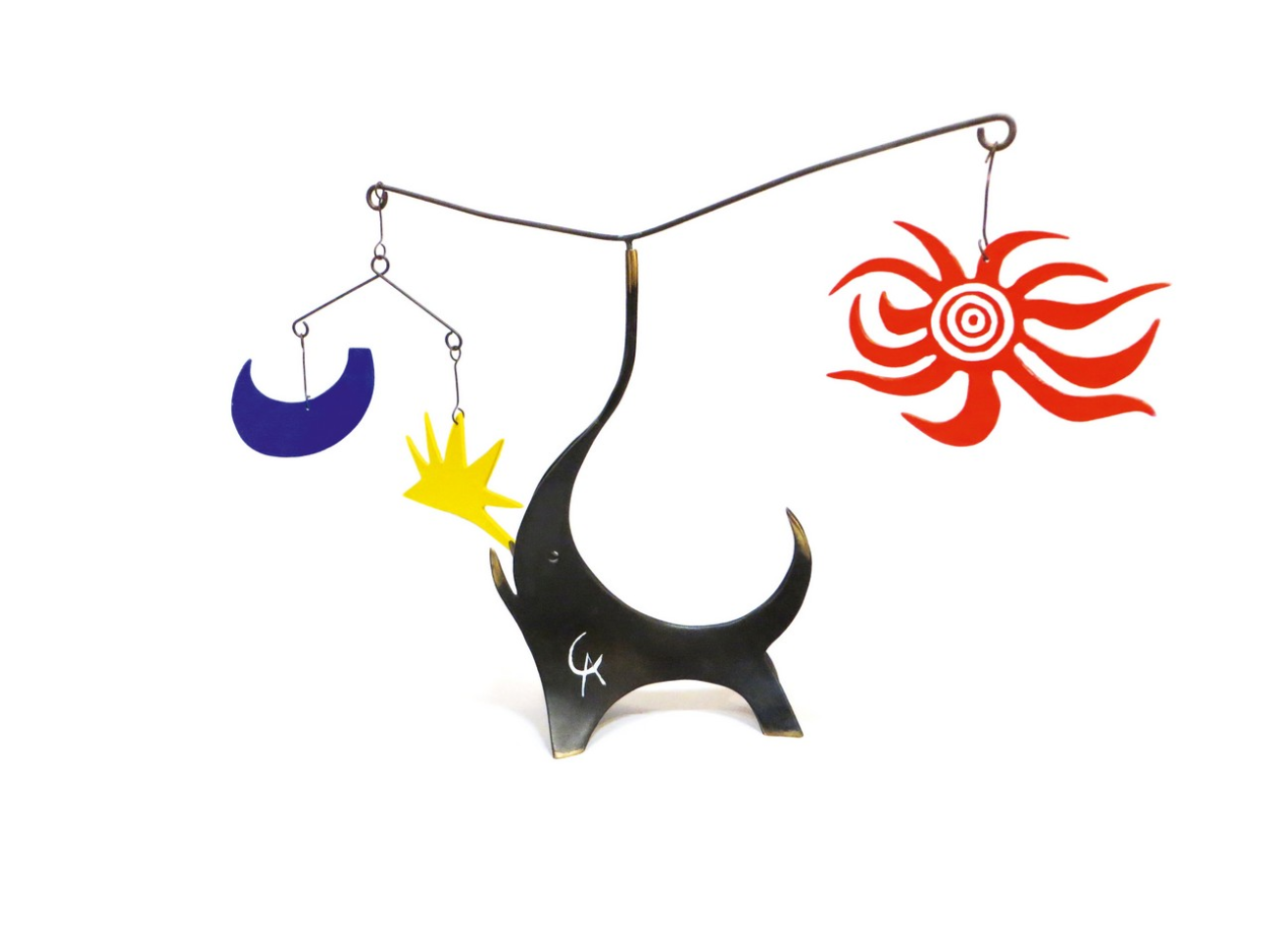
Alexander Calder
<p>Alexander Calder was born in 1898 in Lawnton, Pennsylvania (USA). His father was a sculptor and his mother a painter.</p>
<p>With the support of his father, Calder was encouraged to create. For Christmas in 1909, at age of 11, Calder presented his parents with two of his first sculptures, a tiny dog and duck cut from a brass sheet and bent into formation. </p>
<p>Despite his talents, Calder did not originally set out to become an artist. He instead enrolled at the Stevens Institute of Technology after high school and graduated in 1919 with an engineering degree. Calder committed to becoming an artist shortly thereafter, and in 1923 he moved to New York and enrolled at the Art Students League. In 1926, Calder moved to Paris, enrolled in the Académie de la Grande Chaumière, and established a studio in the Montparnasse Quarter. </p>
<p>In June 1929, while traveling from Paris to New York, Calder met his future wife, Louisa James (1905-1996). They married in 1931. While in Paris, Calder met and became friends with a number of avant-garde artists, including Fernand Léger, Jean Arp, and Marcel Duchamp. Leger wrote a preface for the catalog of Calder's first exhibition of abstract constructions held at the Galerie Percier in 1931. In addition to sculptures, Calder painted throughout his career, beginning in the early 1920s.</p>
<p>Over the course of seven decades, along with his mobiles, he also produced paintings, stabiles, standing mobiles, monumental outdoor sculptures, works on paper, domestic objects, and jewelry. The artist lived in both Roxbury, CT, and Saché, France, before his death on November 11, 1976 in New York, NY.</p>
<p>Today, his works are held in the collections of such major museums as The Museum of Modern Art in New York, the National Gallery of Art in Washington, D.C., the Whitney Museum of American Art, New York, the Art Institute of Chicago, and the Tate Gallery in London.</p>
<p> </p>